Coney Island Food, Wellness & Workforce
-
Coney Island continues to experience significant retail leakage, with residents consistently spending outside the neighborhood due to insufficient local access to essential goods and services.
2025 Studio retail leakage analysis found negative balance across all commercial categories, with the largest gaps in pharmacies ($33M), full-service restaurants ($30.4M), and groceries ($13.7M) — meaning residents are consistently spending outside the neighborhood due to insufficient local supply.
-
Food access disparities further reinforce conditions of neighborhood inequity. Coney Island contains approximately 2,172 residents per food retailer, compared to 1,254 residents per retailer in Brooklyn overall — nearly double the citywide rate. This imbalance underscores persistent food insecurity risks and limited access to affordable, fresh, and culturally relevant food options within walking distance for many residents.
-
In addition to housing and retail challenges, residents identified a decline in stable, year-round employment opportunities that provide sufficient wages for both youth and adults. Seasonal economies, limited local job diversity, and reduced access to career pathways have largely contributed to economic shifts.
Community feedback emphasized the need for strategies that expand local hiring, strengthen workforce development pipelines, and support economic systems that allow residents to both live and work within the neighborhood.
-
63% Not satisfied with the amount of jobs
76% Available jobs are not in line with interests or skills
71% Not satisfied with the variety of local businesses
71% Not satisfied with the variety of food establishments
66% Not able to purchase necessities
-
Grocery Stores (20)
Affordable
Fresh fish market
Healthy/Fruit/Vegetable
Variety of Restaurants (10)
Clothing Stores (4)
Pharmacies (3)
-
All industries, with an emphasis on professional jobs:
Tech
Environmental
Finance
Retail
Hospitality
Not seasonal work
Food Access, Land Use & Zoning
-
![]()
Current Land Uses in Coney Island (excluding Seagate)
Source: NYC PLUTO 2024
This is a land use map showing each lot in Coney Island classified in different colors to show use types: residential, commercial, industrial, transportation, open space and public facilities.
The 2009 Coney Island Rezoning, adopted by the New York City Council on July 29, 2009, aimed to revitalize a 47-acre, 19-block area that had long suffered from fragmented land use, underutilized parcels, and a seasonal economy (NYC Zoning Resolution, 2009). Before the rezoning, much of Coney Island beyond Surf Avenue consisted of surface parking lots, light industrial sites, and large public housing campuses. Commercial corridors were concentrated along Surf Avenue and dominated by amusement related uses, leaving gaps of inactive frontage. Residential areas north of Surf Avenue, including NYCHA developments such as Coney Island Houses, were previously zoned R6, limiting development potential. The neighborhood’s disjointed land uses, declining local commerce, and reliance on seasonal tourism created a context ripe for intervention.
While the rezoning sought to balance housing, retail, and recreation and preserve the historic amusement district, it faced substantial opposition from historians, preservationists, and local stakeholders concerned about the impact on historic buildings, open space, and the character of the amusement area. The rezoning established the Special Coney Island District, dividing the area into four subdistricts (Coney East, Coney West, Coney North, and Mermaid Avenue) to guide denser development, active streets, and improved public space across fragmented areas.
-
![]()
Land Vacancy by Ownership Type (excl. Seagate)
Source: NYC PLUTO 2024
46% of the vacant land use by area is open space, mostly due to the beachfront
14% of lots are multi-family elevator buildings and 12% of the land is used for transportation and utility.
There are 67 total acres of vacant land. This includes open parking facilities and actual vacant land with no current use.
24% of the vacant land is zoned for commercial use, 40% for manufacturing, and 36% residential.
47% of the vacant land is owned by the City, and 40% is privately owned.
Of the vacant land is owned by the City, 61% of the land is zoned for manufacturing uses, 26% commercial, and 13% residential. These lots highlight key areas for further use and for community vision from land transfer from the City.
-
![]()
Groceries & Retail Food Access
There is a dearth of grocery stores and supermarkets in the area, with approximately 2,172 residents per food retailer, a substantially higher proportion than the Brooklyn average (New York State Office of the State Comptroller, 2025). This scarcity contributes to food insecurity, with 20–27 percent of households in Coney Island experiencing limited or uncertain access to adequate food (NYC Food Policy Center, 2023).
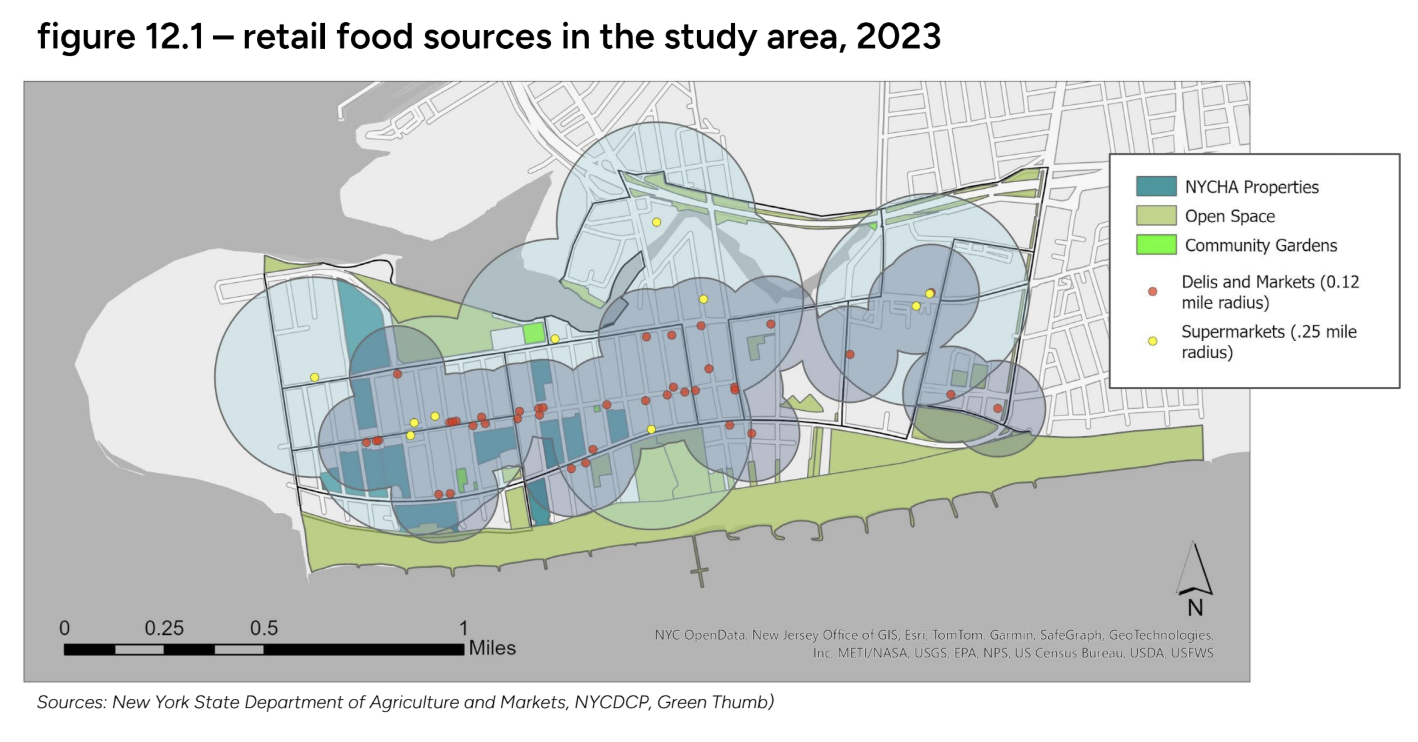
Figure 12.1 maps the retail food stores in the neighborhood. Each yellow symbol represents a Supermarket with at least 4,000 square feet of floor area and fresh produce in stock. The radius around each store is one quarter of a mile (half a mile to walk there and back), a potentially challenging distance for some community members to haul groceries, especially considering the older demographics and high rate of disabled persons.
Among only 10 supermarkets, two are ‘big box pharmacies’ (Rite Aid/CVS) that are not predominantly food suppliers. The map reveals that the distribution of the stores is uneven across the neighborhood, leaving some residents in the south and east in relative ‘food deserts’ (Census Tracts 330, 340, 350, 352, and 356.02). The entire west end is relying primarily on the Key Food on Neptune & W 36th and Washington Cherry Inc on Mermaid and W 30th, overburdening these two stores.
As a result, many households rely on smaller markets and bodegas (shown by red circles on the map), which offer limited fresh produce and frequently have higher prices. Consequently, approximately 30 percent of residents report shopping locally less than twice a month, indicating that they often travel outside of the neighborhood for full grocery shopping needs (NYC Food Policy Center, 2023).
-
![]()
Communal Food Access Networks
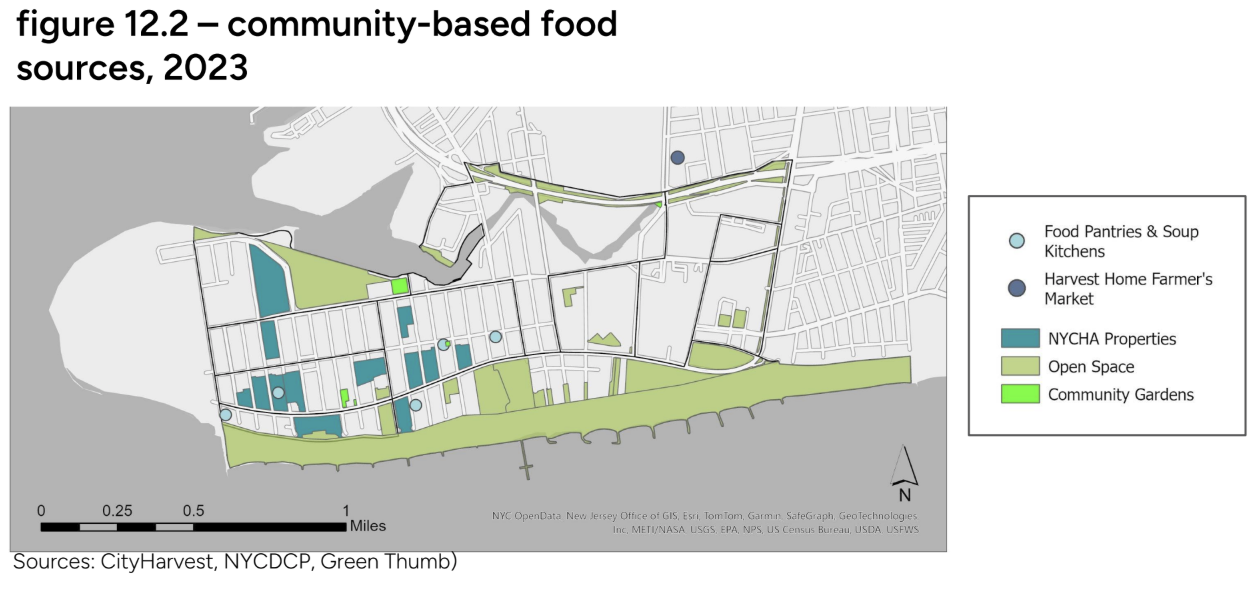
The Harvest Home Farmers Market at Coney Island Hospital (dark blue circle) provides residents with fresh produce and accepts SNAP and Health Bucks, while other programs, such as initiatives by Brooklyn Community Services (BCS), aim to enhance access to fresh, locally grown food for families in Coney Island and other Brooklyn neighborhoods (Brooklyn Community Services, 2024). However, the site is located outside of the neighborhood and thus is not easily accessible to large portions of the community.
The three local community gardens, shown in bright green on Fig. 12.2, also help combat food insecurity in the study area. All are well-maintained and provide not only fresh food but also spaces for community gatherings and events, as evidenced by the stage at the Santos Community Garden below (NYC Green Thumb, 2025). Also of note in Fig. 12.2 are the neighborhood’s four locations that distribute free or heavily discounted food, represented by blue dots. The locations that distribute free or heavily discounted food are:
● ACTS Community Development Corps, Coney Island Lighthouse Mission - Soup Kitchen & Food Pantry (2114 Mermaid Ave, Brooklyn, NY 11224)
● Catholic Charities Brooklyn and Queens, Our Lady of Solace (2866 W 17th St, Brooklyn, NY 11224)
● Kingdom Global Missions (FP) (2945 W 33rd St, Brooklyn, NY, 11224, USA) (City Harvest, 2024)
● Jewish Community Council (JCC) of Greater Coney Island (3001 W 37th St, Brooklyn, NY 11224)
The geography of the community gardens and food pantries alleviates some pressure on the ‘food desert’ census tracts in the west, but not the eastern tracts of 350 and 356.02. There is some notable open space in these areas, which could be developed into additional community gardens or used as a more convenient location for a farmer’s market.


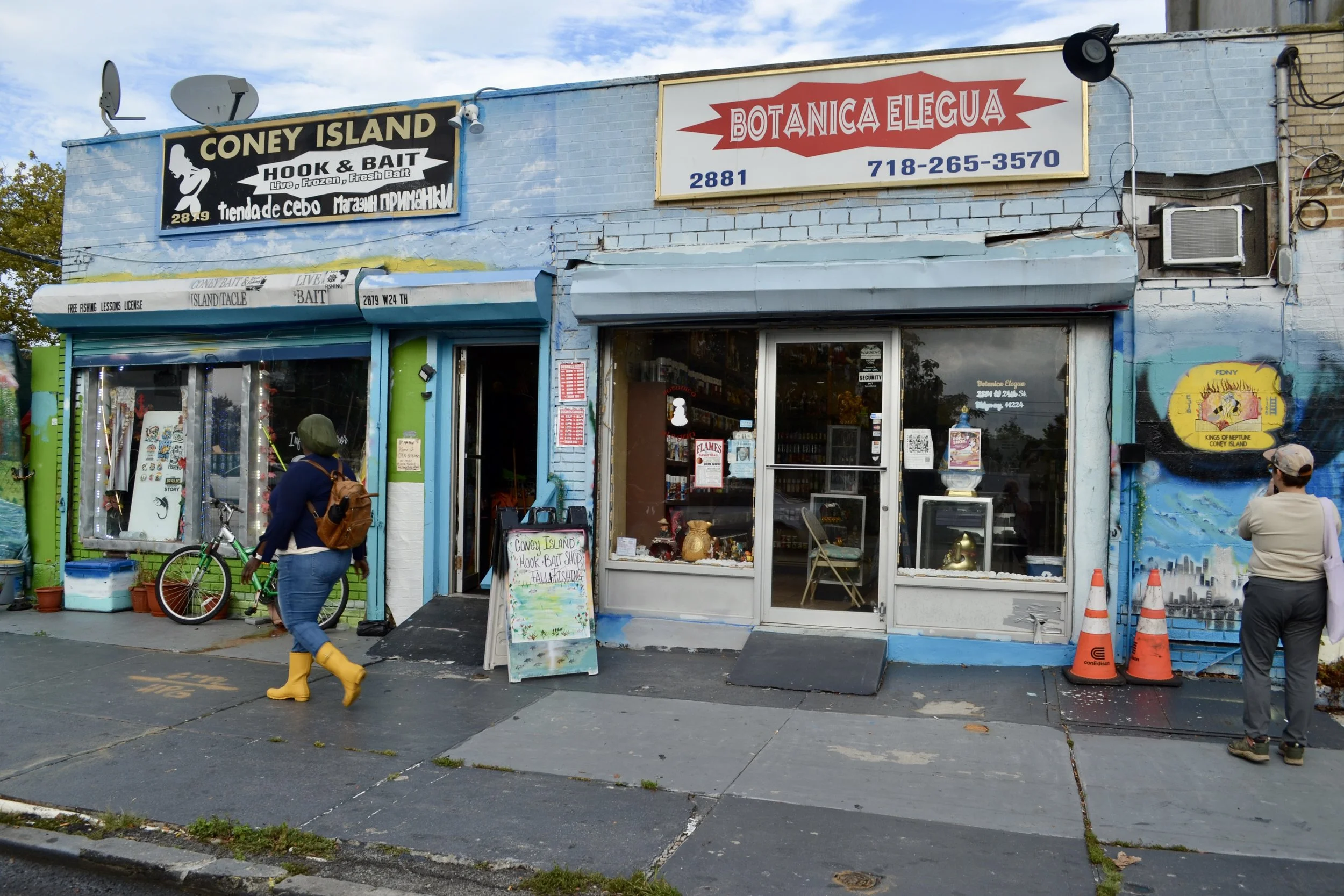
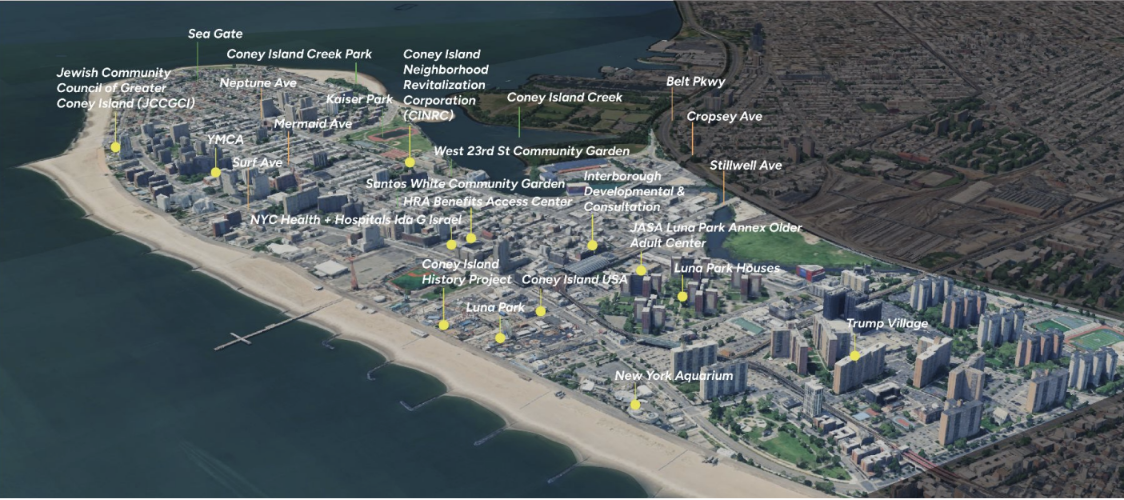
Coney Island's food access network extends far beyond traditional grocery stores. Community organizations, faith-based institutions, food pantries, urban agriculture initiatives, local businesses, and neighborhood advocates collectively provide essential resources that help residents meet their daily needs. These spaces serve as critical components of the neighborhood's social and physical infrastructure, filling gaps where healthy, affordable food options remain limited.
While much of Coney Island's recent development has been concentrated around the entertainment district and shaped by the 2009 Rezoning, many residents continue to rely on locally rooted institutions and commercial corridors for everyday necessities. Strengthening neighborhood-serving retail, supporting locally owned businesses, and expanding opportunities for food access within existing commercial and community spaces can help ensure that future development responds to community needs while promoting a healthier, more resilient local food system. By recognizing and investing in these community-based assets, Coney Island can better align land use planning, economic development, and food security goals to support long-term neighborhood well-being.
Integrate Workforce Development, Food Justice, and Urban Agriculture to Nurture Neighborhood-scale Sustenance
Across engagement activities, residents consistently emphasized the importance of linking workforce development with environmental resilience — particularly through career pathways rooted in green infrastructure, urban agriculture, and community stewardship. These themes collectively point toward a neighborhood future where economic stability, ecological health, and community self-determination are built through interconnected, hyperlocal systems.
-
Residents and stakeholders identified a growing need for accessible career preparation and workforce training programs aligned with emerging green economy opportunities. This includes training pathways in environmental remediation, landscape maintenance, climate resilience infrastructure, horticulture, and community-based sustainability work.
Community feedback emphasized the importance of locally rooted programs that provide youth and adults with practical skills, paid training opportunities, and clear pathways into stable employment that contributes directly to neighborhood improvement and environmental stewardship.
-
Community members highlighted community gardening within NYCHA and other public housing green spaces as a critical tool for advancing food sovereignty, strengthening neighborhood cohesion, and improving access to fresh, culturally relevant food. These spaces were consistently described as more than recreational amenities — functioning instead as sites of care, cultural continuity, and intergenerational knowledge exchange.
Residents emphasized the importance of expanding support for resident-led gardening initiatives that enhance both environmental quality and everyday food access within housing communities.
-
Residents also expressed strong interest in expanding hyperlocal urban agriculture networks that connect private, public, and community-managed growing spaces across Coney Island. These networks were envisioned as systems that strengthen local food distribution, support small-scale economic activity, and reinforce ecological stewardship at the neighborhood scale.
By linking existing gardens, vacant lots, school gardens, and housing-based growing spaces, community members identified opportunities to build a more resilient and self-sustaining local food ecosystem rooted in shared stewardship and neighborhood collaboration.